
Leveraging AI and Micro-Credentials in Education: Insights from the EduAId Project
Artificial Intelligence (AI) is no longer a distant concept in education. Across classrooms, lecture halls, and vocational training centers, AI-driven tools are beginning to reshape how teachers teach, how students learn, and how institutions measure and recognize skills. Yet, the integration of AI into education remains complex, fragmented, and often uneven.
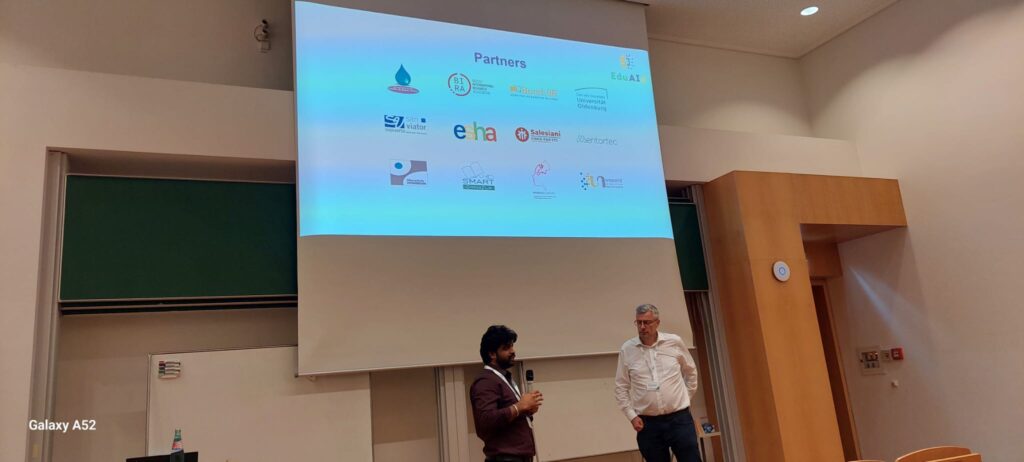
The Erasmus+ EduAId project addresses this challenge by systematically reviewing and analyzing real-world applications of AI in education, with a particular focus on micro-credentials as a mechanism for skill recognition and lifelong learning. Recently, the EduAId consortium presented its paper, “Leveraging AI and Micro-Credentials in Education: Insights from the EduAId Use Case Review”, at the SAP Academic Community Conference DACH 2025 under the Technology and Digital Transformation track. The presentation, delivered by project coordinator Sasapu Venkatesh, engaged an audience of approximately 300 participants and generated constructive discussion. As a result, the consortium received 10 structured feedback responses from attendees, highlighting both the strong interest in the topic and the growing relevance of EduAId’s work in the evolving landscape of AI-enabled education.
Mapping the AI in Education Landscape
The paper draws on more than 20 validated use cases of AI across primary, secondary, vocational, and higher education. Rather than looking at AI in education in purely technical terms, the EduAId team examined the cases through five analytical dimensions:
- Pedagogical Integration – How AI supports or transforms teaching and learning practices.
- Ethical and Regulatory Alignment – The degree to which AI initiatives comply with data protection, fairness, and transparency requirements.
- Personalization and Learner Agency – How AI tools empower learners to take control of their educational journeys.
- Institutional Readiness – The capacity of schools, universities, and vocational institutions to implement AI meaningfully.
- Micro-Credentialing Mechanisms – The potential for AI-driven learning to be formally recognized and linked to lifelong learning pathways.
This multidimensional approach paints a nuanced picture: while AI has enormous potential to make education more adaptive, personalized, and inclusive, its adoption is uneven and faces barriers related to governance, interoperability, and institutional culture.

Key Findings
Several promising outcomes emerged from the review:
- Enhanced student participation through adaptive learning tools and personalized feedback mechanisms.
- Teacher support, especially in areas such as grading automation, lesson planning, and learner analytics.
- Improved accessibility, with AI tools supporting learners with special needs and diverse learning styles.
At the same time, significant challenges remain:
- Institutional embedding – many AI tools are piloted but not fully integrated into curricula.
- Explainability and transparency – educators and learners often do not fully understand how AI models make decisions.
- Credential portability – while micro-credentials offer flexibility, there is still a lack of interoperability between platforms and systems.
These insights reflect a vibrant but fragmented ecosystem: promising innovations exist, but their benefits cannot be fully realized without a stronger framework for integration, ethics, and recognition.
The Role of Micro-Credentials
One of the central contributions of the EduAId project is the link between AI-driven learning and micro-credentials. Micro-credentials are small, verifiable certifications that recognize specific skills or competencies. They are becoming increasingly important in a world where lifelong learning and upskilling are essential.
The EduAId team argues that micro-credentials, if designed in alignment with AI-driven learning outcomes, could provide a bridge between informal learning experiences and formal recognition. However, for this to succeed, systems must be:
- Interoperable – allowing learners to carry credentials across institutions and platforms.
- Ethically grounded – ensuring that credentials reflect fair and transparent AI processes.
- Pedagogically meaningful – linked to real learning outcomes, not just technical achievements.
Feedback and Next Steps
Participants welcomed the structured analysis of the presentation and emphasized the urgency of addressing key gaps in explainability, ethical governance, and credential portability. The discussion further underscored the importance of co-designing AI systems with educators, learners, and policymakers to ensure alignment with real-world needs.
Building on this momentum, the EduAId consortium plans to publish further studies and case analyses in the coming months. These will deepen our understanding of how AI can support teacher empowerment, student engagement, and institutional transformation—always with an eye on ensuring ethical, transparent, and inclusive integration.
Why This Matters
AI will not replace teachers, but it will undoubtedly transform their roles. As classrooms become more digital and learning increasingly personalized, the challenge is not whether to adopt AI, but how to do so responsibly and meaningfully. Micro-credentials offer a powerful tool to recognize learning achievements in this evolving landscape, but they require thoughtful design and alignment with AI-driven processes.
EduAId’s work shows that success lies in a balanced approach: combining technological innovation with pedagogical insight, ethical awareness, and institutional readiness. By fostering collaboration between educators, technologists, and policymakers, we can move toward a AI enhances learning for all, rather than creating new forms of inequality.
Conclusion
The EduAId project’s use case review marks an important step toward understanding and shaping the integration of AI in education. By focusing on real-world applications, ethical alignment, and the potential of micro-credentials, EduAId contributes to building a research- informed and policy-aligned roadmap for the future.
The consortium is excited to continue this journey, sharing results, engaging with stakeholders, and advocating for sustainable, inclusive, and meaningful integration of AI in education.
Stay tuned – more publications and insights from EduAId are on the way!